VATICAN CITY (RNS) — Early on, Pope Leo XIV signaled support for women’s leadership in the Catholic Church, but a new Vatican decision released on Tuesday (June 23) barring laypeople, including women, from preaching the homily at Mass is testing how far that openness is likely to go.
“ … It is not possible … to permit, in exceptional circumstances, a duly commissioned lay member of the faithful to preach in place of the homily during the celebration of the Eucharist,” read the statement published by the Vatican Dicastery for Divine Worship and the Discipline of the Sacraments, which oversees liturgy for the Catholic Church.
The document referred to a letter sent by the president of the German Bishops’ Conference, Bishop Heiner Wilmer, dated June 17, which asked to allow laypeople — including women — to preach the homily at Mass.
The Vatican stated that the homily at Mass is exclusively “entrusted to ordained ministers through the Sacrament of Holy Orders” and is tied to the nature of the liturgy. It also noted that under canon law, laypeople have other avenues for proclaiming the gospel, including catechesis and preaching outside of Mass.
As a missionary and later bishop in Peru, the future pope reportedly encouraged women lay leaders to offer reflections during Mass, according to Elise Ann Harris Allen’s newly released book, “Pope Leo XIV: The Biography.” Since his election he has signaled openness to women in visible church roles. But the Vatican’s decision suggests that Rome’s promises of greater lay and female participation, emphasized during the global Synod on Synodality, still have firm limits when it comes to the liturgy and ordained ministry.
While the letter sent by the German bishops is not public, the Catholic German news site Katholisch.de reported that Wilmer had proposed to the Vatican that laypeople be allowed to make a “Predgit” (a broader German term for sermon) during Mass, while the homily would remain exclusive to ordained ministers.
German bishops have been at odds with the Vatican on several issues, including the blessing of same-sex couples and the role of laypeople, especially since the German synodal process (or Synodal Way), a sweeping church consultation process in the country that ran from 2019 to 2023 and emerged in response to the church’s sexual abuse crisis.
The head of the Vatican’s liturgical department, Cardinal Arthur Roche, wrote to the German bishops in 2023 to reject proposals to allow laypeople to preach at Mass and perform baptisms. Roche also participated in the Vatican-German bishops’ meetings in 2024, which attempted to address some of the tensions raised by the Synodal Way.
According to a spokesman for the German bishops, Matthias Kopp, the bishops’ conference took note of the Vatican’s decision and addressed it during the conference’s meeting in Berlin but has not yet issued a public response.
The Catholic Women’s Association of Germany, which also took part in the Synodal Way, stated that the Vatican’s decision highlights the church’s unwillingness to promote women’s roles. “As long as women, despite their competence, vocation and commitment, remain excluded from central ministries, the church will continue to lose credibility,” read a statement signed by the group’s spiritual director, Ruth Fehlker.
“The decision shows once again how wide the gap is between the pastoral realities of many local churches and the directives from Rome,” it read.
The executive director of the U.S.-based advocacy group for women’s ordination and gender equality in the church, Kate McElwee, called the Vatican’s decision “shameful” and “insulting” in a text message to Religion News Service.

Women’s Ordination Conference Executive Director Kate McElwee addresses WOC members during the “Let Her Voice Carry” vigil in the Basilica of St. Praxedis in Rome, Oct. 3, 2023. (AP Photo/Gregorio Borgia)
“There are countless qualified, trained, and prepared lay people, especially women, ready to preach during Mass — and even more Catholics ready to receive the gift of their wisdom,” she wrote, adding that women’s experiences and perspectives can enrich the understanding of Scripture in ever more inclusive ways.
“What this clarification really reveals is the extent to which the Vatican will go to try to stop the Holy Spirit,” McElwee said, adding that it “doubles down on exclusion instead of listening to the needs of Catholics today.”
The Vatican’s decision awkwardly lands just as Leo is scheduled to oversee major gatherings of bishops and cardinals discussing the implementation of the Vatican’s Synod on Synodality, a global consultation of Catholics called by Pope Francis between 2021 and 2024, which called for broader participation of laypeople and especially women in the church.
The heads of bishops’ conferences representing all continents were at the Vatican this week and will meet the pope on Thursday, while cardinals will also be convening at the Vatican Friday through Sunday for Leo’s first extraordinary consistory addressing synodality, among other things.
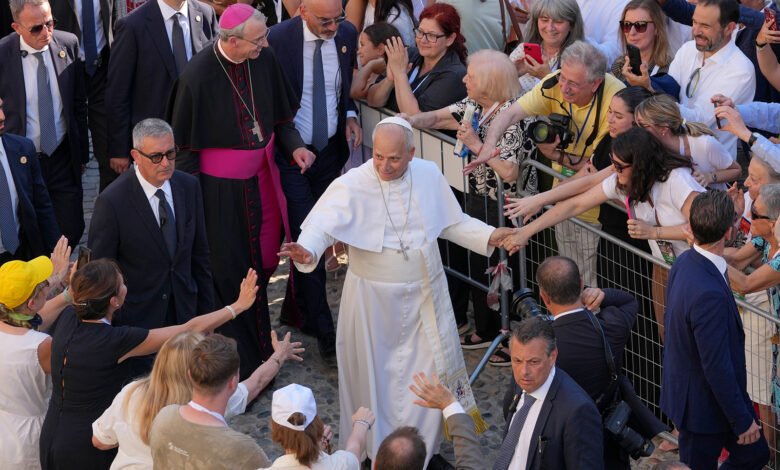
Since his election, Leo emerged as a promoter of women’s leadership roles in the church. He recently appointed the first woman to lead the Vatican’s communication department, Maria Montserrat Alvarado. The pope also raised some eyebrows by being assisted by two female altar servers during his first public Masses in Roman parishes.
When he was a missionary and bishop over two decades in Peru, Leo was viewed as a supporter of women’s participation in the church and reportedly encouraged women preaching the homily at Mass. Alicia Azabache Arroyo, a woman attending what is now called the Santa Rita de Cascia parish, in Trujillo, Peru, said that the Rev. Robert Prevost, as Leo was then known, urged her to get involved in parish life and even the liturgy.
In Leo’s biography by Harris Allen, Arroyo clams that one Sunday Leo asked her to “give the homily,” adding that she “wasn’t supposed to do it in the classic sense of the word,” later referring to is as “a reflection” during Mass.
Arroyo and other women describe Leo in the book as empowering women to lead and guide the church and parish in many ways, as treasurers and lay organizers, describing it as a “synodality before synodality.”
The Vatican’s recent decision simply reaffirmed canon law and was “not surprising,” according to Casey Stanton, co-director of Discerning Deacons, a U.S.-based group advocating for women to become deacons, who may preach, baptize, witness marriages and assist at Mass but cannot consecrate the Eucharist or hear confessions.
Stanton said the decision raises a question: “Is the code of canon law — that isn’t gospel — something that changes, that is revised, that is updated?
“My hope for Pope Leo would be that he would continue to trust in processes and also initiate them,” she added.
Source link