
SCIENCE
-
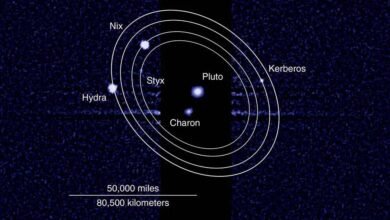
The science case for why Pluto should become a planet (again)
In 2006, the IAU defined “planet” for the first time, excluding Pluto and all other dwarf planets. In 2026, is…
Read More » -
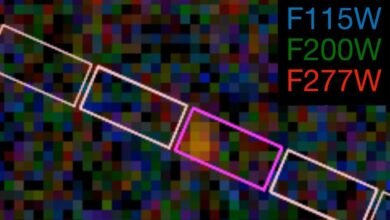
Ask Ethan: How can ultra-distant galaxies move so fast?
It takes incredible energies to accelerate masses near the speed of light. So how do the farthest galaxies speed away…
Read More » -
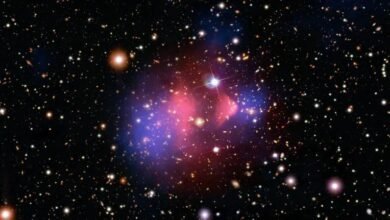
Dark matter in the Bullet Cluster celebrates 20 years
The first colliding galaxy cluster to reveal dark matter, empirically, turns 20 this year. Here’s why it cements dark matter’s…
Read More » -
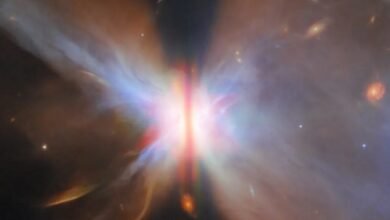
Ask Ethan: What’s the biggest misconception in astronomy?
Many facts are well-known to professionals, but are unappreciated or even rejected outright by the public. “How stars work” takes…
Read More » -

The idea of “theories of everything” may be fundamentally wrong
For decades, theorists have been cooking up “theories of everything” to explain our Universe. Are all of them completely off-track?…
Read More » -
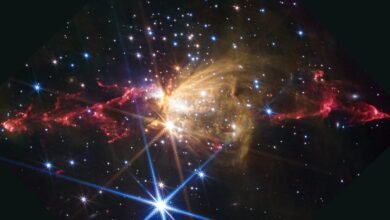
Star birth doesn’t come from ignition, but from equilibrium
Although a star’s “birth” is well-defined, it doesn’t correspond to an ignition event in its core. Here’s how stars are…
Read More » -

Ask Ethan: How long does it take planets to form?
Every time a new star forms, there’s an opportunity to form planets alongside and around it. How does it happen,…
Read More » -

Everything in the Universe changes by adding enough mass
One parameter, alone, sets the dividing line between rocky planets, gas giants, brown dwarfs, stars, and much more. Here’s why…
Read More » -
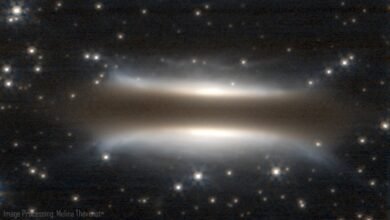
Starts With A Bang #128 — Planet formation and proto-protoplanets
By looking at a giant, remarkable, edge-on protoplanetary system, astronomers have found a proto-protoplanet for the first time. Continue reading…
Read More » -

To alien eyes, Earth looks deceptively peaceful
As the world teeters on the brink of nuclear war, distant, advanced civilizations would never know it. Earth appears peaceful…
Read More »