
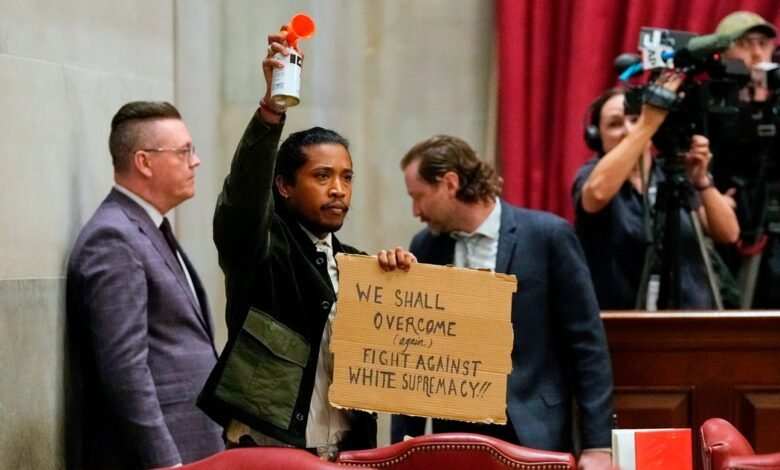

Justin Jones protests this year’s gerrymander in Tennessee.
Photo: George Walker IV/AP Photo
Many view this year’s gerrymandering battles as merely another skirmish between Democrats and Republicans for control of the U.S. House of Representatives. But for some southern Black Democrats, it’s the latest saga in a sad story as old as time.
A central question during the decades-long struggle that led to the Civil War was whether northern white people would risk limb and life to challenge the peculiar institution of African slavery. After that war was won, those same northern white people were ambivalent about troubling themselves to ensure that southern white people didn’t effectively re-enslave the ex-enslaved people via terrorism and various restrictions on their right to vote, earn a living, and move around freely. That was true even in the ranks of the Republican Party, which largely abandoned federally enforced Reconstruction of the South in 1876 in order to win a contested presidential election. The creation of the full Jim Crow system of institutionalized white supremacy in the South proceeded over the next several decades with little or no interference from outside the region.
The abandonment of southern Black people continued even as progressive Democrats gradually became interested (in theory at least) in their plight. New Dealers and their progeny recognized the incredible injustices being meted out by their Democratic allies south of the Mason-Dixon Line but depended too much on southern white support to do anything about it. It took a southern-generated civil-rights movement, and a brutal southern reaction to it, to arouse the conscience of the nation. But even then the leadership of both major parties fretted over white “backlash,” and Republicans gradually and then eagerly became the “white man’s party.” In fits and starts Democrats lost political power in the South and could really only do anything constructive for southern Black people via federally enacted voting-rights and social-services legislation, giving a racial tinge to every conflict in Washington over “big government” and taxing and spending decisions. The federal courts became the last resort for vindication of civil rights, and thus the struggle for control of the Supreme Court became the ultimate battleground.
Today, from the perspective of many southern Black leaders, the battle is being lost. A virulently reactionary strain of white Republicanism has an iron grip over much of the South. A virulently reactionary GOP has trifecta control of Washington and is renewing the party’s ancient war on those elements of the social safety net that don’t principally benefit white people. And the Supreme Court has been conquered as well as most clearly evidenced by the evisceration of the Voting Rights Act of 1965, culminating in the Louisiana v. Callais decision in April that unleashed a joyful wave of Deep South gerrymandering that is likely before long to decimate the ranks of Black legislators in state capitals and in Congress. The sense of history being rolled back was palpable when Callais came down, leading Cristian Farias to lament at New York that the decision “stands to turn the South into a neo-Confederacy and that threatens the very idea, written into the text of the post–Civil War amendments that we live in a multiracial democracy.”
And what are non-southern Democrats doing about it, once the initial cries of protest subsided? They’re eagerly planning counter-gerrymanders in the (much fewer) states they control, all but one (Virginia, where in May the courts blocked a Democratic gerrymander) outside the South, as part of the sandbox game for control mentioned above. And once again, many Black Southerners are feeling abandoned, as Politico reports:
Black lawmakers and activists across the Deep South argue they have been abandoned by the Democratic Party to fight an existential crisis on their own. They say they’ve been let down by nearly all corners of the party: would be-presidential hopefuls who have flocked to early and swing states but don’t bring their megaphones elsewhere; congressional leadership focused on majority-making battlegrounds while safe Black seats are drawn out; and years of chronic underfunding that has allowed local party apparatus to wither away.
“Folks who lead our party go to swing states like North Carolina and Georgia, but states like Mississippi and Tennessee and Alabama and South Carolina are really neglected and are really forgotten and are really treated as if it is inevitable that we’ll always stay in such systems of what I call apartheid type of politics,” said Tennessee state Rep. Justin Jones.
The targets of this concern, to be clear, include some Black members of Congress who still have safe seats and will benefit from the privileges of the majority if Democrats win back the House, Politico also notes:
Even the chair of the Congressional Black Caucus PAC, the campaigning arm of the entirely Democratic 62-member caucus, said in a previous interview that its focus remains taking back Congress.
“The PAC has always been focused on electing Democrats in tough seats so that we can reclaim the majority. That goal, that focus, has not changed,” Rep. Gregory Meeks (D-N.Y.) told POLITICO in May, shortly after the Callais ruling came down.
It’s true as well that busting up the GOP trifecta in Washington is essential to the battle against that other, more pervasive threat to southern Black folks, the erosion or extinction of low-income entitlement and anti-poverty programs. But once again, there’s a sense that Black Southerners, denied their own full representation in Congress, will have to rely on the beneficence of people elsewhere, which has been a poor bet over the years.
Beyond their engagement or nonengagement in southern gerrymandering battles, if Democrats ever do regain the power in Washington to do big things, a key question will involve their willingness to prioritize the restoration of Black voting and representation rights. The conservative majority on the Supreme Court and the Republican domination of southern states aren’t going to change overnight. Maybe it will all get turned around someday, but for now, as my colleague Zak Cheney-Rice recently observed: “The soldiers and heirs of the civil-rights movement — many of them elderly and ailing — are seeing their life’s work dismantled.” And their own younger heirs could be losing hope.
Source link