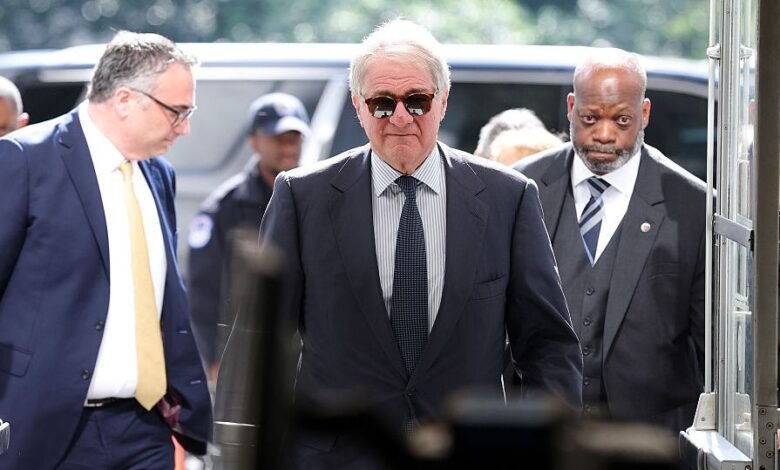

Leon Black gave Jeffrey Epstein a lot of money. Between 2012 and 2017, the billionaire private-equity investor paid the convicted sex offender $158 million for tax and estate advice — far more than the going rate on Wall Street. While facing scrutiny for these payments in 2021, Black resigned from his position leading the firm he founded, Apollo Global Management, and his seat on the Museum of Modern Art’s board, citing “health issues.” Since then, he’s largely stayed out of the public eye— save for an appearance in May at Madison Square Garden during the New York Knicks championship run. But he was back in the spotlight on Friday in Washington to face questions about his relationship with Epstein.
Black appeared before the House Oversight Committee as part of its ongoing investigation into the accused sex trafficker and his elite connections. “Of all the witnesses that have come thus far, this one has the potential to be the most groundbreaking deposition,” Oversight chair James Comer said shortly before the hearing began.
The deposition was held behind closed doors, though the committee will release a transcript in the coming weeks. But a written statement from Black, who has always denied knowledge of Epstein’s trafficking, provides a window into his explanations to the House members. So far, the results of the interview suggest it didn’t go well. Comer announced shortly after the hearing that he had subpoenaed Black on the spot and that he will be returning on July 16 to answer more questions.
“I have never paid Epstein for access to women. I was never blackmailed by Epstein,” Black said in a written statement. “I was not involved with, and had no knowledge of, any of Epstein’s heinous conduct.” He says that he first met Epstein in the early 1990s — back when he was a close friend of Donald Trump’s and serving on the board of Rockefeller University. He said he knew Epstein for close to 20 years “before I paid him a dime.” In 2013 — four years after Epstein’s release from prison — Black started paying him for “bona fide advice” on his taxes and his estate, citing his “remarkable acumen” in accounting. As for the whole going-to-prison-for-soliciting-a-minor thing, Black said he thought it was an “isolated incident.” In the end, Black says he was swindled of $60 million in fees after Epstein lied to him and told him they were tax deductible.
“I now know, as does the world, that Epstein was engaged in horrific, sordid activities,” Black said, adding, “I knew Jekyll. I didn’t know Hyde.”
Now, if only there were a massive database of material released by the federal government that could show whether Black paid Epstein for more than just financial advice.
As it turns out, the New York Times dug into the Epstein files in March, finding emails between Black and Epstein discussing how to obscure millions of dollars’ worth of payments to women Black allegedly had affairs with. The emails show Epstein introducing Black to young women — including three women who later claimed Black sexually assaulted them, which he has denied.
In one instance in 2015, Epstein counseled Black’s top adviser, Brad Karp, on how to keep one of Black’s alleged girlfriends quiet as she pushed him for a $100 million hush payment. Epstein and Karp exchanged emails about strategy as the private investigator managed to tape a series of lunches between Black and his alleged mistress with the goal of reducing her demands and getting her to say on tape that she was never assaulted by Black. (The Epstein files contain the transcripts.) In October 2015, Black paid her $18 million. The same month, Black made a new payment to Epstein for $20 million. Epstein’s attorneys say that the payments were strictly for financials deals and that the emails “make clear that Mr. Epstein embellished, exaggerated and lied about Mr. Black.” But one Epstein email from 2017 indicate he may have played a different role in Black’s life. There, Epstein wrote to Black about “saving you from yourself.”
Whether or not Black knew the Mr. Hyde side of Epstein, he did tell Puck in 2024 that his former adviser was “like a Bond villain.” As for the “isolated incident” of Epstein’s arrest, communications from that time suggest a different story. When Epstein was released from prison in 2011, emails show that an assistant told Epstein that Black wanted to sing him “Happy Days Are Here Again.” He replied, “If i have to listen i’d rather be in jail.”
Just after the interview ended early Friday afternoon, Oversight members came out of the deposition room fuming. “Leon Black was arrogant. He was smug,” said Democratic Representative Yassamin Ansari. “He refused to answer the questions, but at the same time he was emphasizing how he was being transparent because this was voluntary.” Both she and Representative Comer, a Republican, said that Black refused to answer questions regarding the NDAs he had signed with women allegedly connected to Epstein. He gave so many nonanswers that Comer subpoenaed him on the spot for a date on July 16. On his walk through the hall, a reporter asked him, “Mr. Black, why would you not answer any questions?” He did not answer the question.
Source link