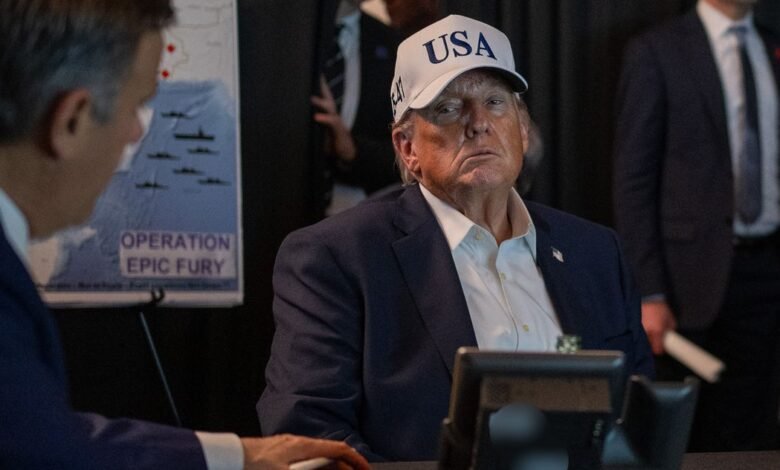

Trump in Mar-a-Lago’s temporary Situation Room as the war began early Saturday morning.
Photo: Daniel Torok/White House/Handout
When President Donald Trump introduced his new war in Iran on Saturday, he closed by offering the Iranian people a breathtakingly confident claim:
To the great, proud people of Iran, I say tonight that the hour of your freedom is at hand. Stay sheltered. Don’t leave your home. It’s very dangerous outside. Bombs will be dropping everywhere. When we are finished, take over your government. It will be yours to take. This will be, probably, your only chance for generations.
This invitation to revolution followed a list of more prosaic military objectives: The U.S. would destroy Iran’s “missiles and raze their missile industry to the ground,” “annihilate their navy,” neutralize its regional proxy forces, and “ensure that Iran does not obtain a nuclear weapon.” He also extolled “the strength and might of the United States armed forces,” boasting, “I built and rebuilt our military in my first administration, and there is no military on Earth even close to its power, strength, or sophistication.” He has since repeated these claims, and though the opening air strikes of the war killed Iranian supreme leader Ali Khamenei and numerous other senior officials, the regime still appears intact. Trump has also repeated his calls for Iranians to rise up against that government. “The rest will be up to you, but we’ll be there to help,” he said in a video address on Sunday.
Taking Trump at his word (if that’s ever a good idea), the goal of “Operation Epic Fury” is to destroy the political and military infrastructure of the Islamic Republic, forcing a fundamental reform of the Iranian state. Ideally, this would create an opportunity for an Iranian popular uprising to overthrow the regime entirely, replacing it with a more liberal, western-oriented state that would align with U.S. interests in the Middle East. In Trump’s fantasy, Iran’s elite military forces, many of them fanatically loyal to the regime, will literally just “surrender to the people, if you think about it,” as he put it in a brief interview with the New York Times on Sunday evening.
But Trump on some level must know this is bullshit, and perhaps that is why he is also talking about a very different vision of post-Khamenei Iran. “What we did in Venezuela, I think, is the perfect, the perfect scenario,” he told the Times. In other words: a regime that continues to repress and immiserate its own citizens, albeit maybe a little bit less, but is cowed into compliance with a more limited set of American demands. Given how fundamental animosity to the U.S. is to the core identity of the Islamic republic, this scenario seems fantastical as well.
As it did in Venezuela, the Trump administration would need to find a figure within the Iranian Establishment with the legitimacy to take charge of the existing government who would also be willing and able to steer Iranian policy in a pro-American direction. Even if such a willing partner could be found, the structure of the Islamic republic would make it practically impossible for them to undermine the regime’s core principles. Trump told the Times he had “three very good choices” to lead Iran but refused to say who they were or how he would ensure one of them ends up in power. Then he told ABC News that the initial attack on Iran’s leadership “was so successful it knocked out most of the candidates … It’s not going to be anybody that we were thinking of, because they are all dead.”
Whoever’s left alive, a more likely outcome is that Iran remains a repressive theocracy hostile to the U.S. and Israel but is so broken that it is no longer able to project power anywhere. Yet Iran’s power had already been severely degraded through economic sanctions, Israeli campaigns against Iranian regional proxy forces, and the joint American-Israeli bombing campaign against Iran’s nuclear and military infrastructure last summer. Iran had indeed scrambled to rebuild its capabilities since that attack, but Trump’s claims that Iran had enough nuclear material to build a bomb within “days” and would soon develop long-range ballistic missiles capable of hitting the United States were not supported by the findings of U.S. intelligence agencies or independent experts.
In other words, there was no need for a full-scale war as Iran posed no imminent threat. The regime was already weak, fragile, and sclerotic, to the point that it would have been surprising but not shocking to see it collapse on its own, without U.S. or Israeli intervention, this year. The only real reason to launch this war was to accelerate its demise: a long-standing object of desire for Iran hawks in both Jerusalem and Washington, D.C. Israeli prime minister Benjamin Netanyahu said it himself on Sunday, that Trump’s military cooperation had enabled him to “carry out what I’ve yearned to be carrying out for 40 years — pounding the Iranian regime.” It is hard not to wonder whether Trump’s and Netanyahu’s personal animosities toward Iran and Khamenei himself motivated this war more than calculated strategic interests.
The somehow unlearned lesson of the past quarter-century of U.S. foreign policy is that American military supremacy does not actually enable American presidents to dictate the outcomes of their interventions abroad, no matter the “power, strength, or sophistication” of our armed forces. There is still no coherent case for how this bombing campaign will lead to regime change, nor is there any way to ensure that what comes after the regime, if it does fall, is better for the Iranian people or U.S. interests.
Iranians of all people know that things can always get worse and that revolutions don’t necessarily result in freedom. What exactly is the dream of regime-change advocates in Washington? That a ragtag band of fed-up everyday Iranians — like those who took to the streets in January, after Trump vowed to protect them, and were then slaughtered by the thousands — storm the halls of power in Tehran then manifest and establish some kind of liberal, secular democracy? That this new government will somehow possess the political will and legitimacy to abandon uranium enrichment, scuttle Iran’s ballistic-missile program, defund its regional proxies, and join the American sphere of influence?
And how exactly is any of this supposed to happen? Who will lead this supposed new regime? Reza Pahlavi, the exiled former crown prince, plays himself up as a potential leader, perhaps of a restored monarchy with constitutional guardrails and democratic institutions (unlike that of his father, who was deposed in the 1979 revolution). Pahlavi, who has lived in exile in the U.S. for nearly half a century, is Iran’s most high-profile opposition figure, and while he likely enjoys some base of support in Iran, there is no evidence he is as popular there as he is in Washington, Los Angeles, and London.
More importantly, he has no apparent means of seizing power, at least not without U.S. or other foreign forces landing in Tehran and installing him —which no one, including Trump, who has never even come close to signaling support for Pahlavi, seems remotely inclined to do. Even Senator Lindsey Graham, the Iran superhawk, has explicitly said there will be no American boots on the ground in the country.
Iran’s ability to project power beyond its borders may be at a nadir, but as its recent massacres of protesters have shown, the regime remains willing and able to use extreme violence to quell domestic uprisings. Largely unarmed protesters are no match for the well-armed Islamic Revolutionary Guard Corps and pro-regime paramilitary forces. Iran’s elites would have no compunction about killing tens of thousands of civilians if that were the price of the Islamic Republic’s survival — after all, it’s happened before, and they’ve been preparing for this very scenario. Furthermore, despite widespread discontent, plenty of Iranian citizens continue to support the clerical regime; any effort to overturn it would be met with popular resistance, perhaps escalating to civil war.
Unfortunately, the likeliest outcome of a regime collapse in Tehran remains as it has been for many years: The IRGC is still the most powerful force on the ground in Iran and is best positioned to step into a governing role. Prior to this war, the CIA assessed that if Khamenei were killed, he would likely be replaced by hardline figures from the corps. In other words, the Islamic Republic might simply be replaced by an even more militarized, paranoid, vengeful, and violent version of itself. The only way of making that outcome less likely would be a long, expensive, uncertain effort by the U.S. and its allies to invade the country or arm and support opposition forces in the hopes of installing a secular, democratic, pro-western government — and we saw how well that went in Iraq and Afghanistan. In Syria, where the U.S., Turkey, and others backed rebel factions fighting to overthrow Bashar al-Assad, the resulting civil war took countless lives, reduced much of the country to rubble, displaced millions, prompted a refugee crisis in Europe, led to the creation of ISIS and then a U.S. military intervention and war to defeat ISIS, and it took more than 13 years before Assad was finally ousted and the regime was changed.
Trump’s ostensible vision of a grateful Iranian people building a vibrant democracy from the craters of American and Israeli bombs is (to put it in language the president understands) a big, beautiful dream. But it is only a dream, and dreams are not strategies. And even if Trump did have a nation-building strategy for Iran, there’s little reason to think it would work. The cost and risk involved is more than the American public would be willing to undertake, and the time and effort it would require far exceed this president’s attention span.
Source link