
(RNS) — Sean Sutton was preaching at a small Bible camp in Georgia last year when he noticed a group of children and young adults focusing intently on building a small model of the tabernacle — they were using bricks repurposed from a Lego Minecraft set to recreate the tent-like sanctuary that housed the ark of the covenant, described in the Bible’s Book of Exodus.
Sutton, a 28-year-old entrepreneur, realized he could use brick sets as a missionary tool to reach children. In May he launched a Kickstarter campaign and quickly raised $10,000 to manufacture his own tabernacle set. He eventually pre-sold around 6,500 of them and raised more than $245,000, allowing him to found his new company, Bible Bricks.
The Wilderness Tabernacle — complete with a figurine of the Israelite high priest, blue Ten Commandments tablets, and goats and sheep for sacrifice — will start shipping next month.
“A lot of us grew up with Legos and understand how fun they are,” Sutton, who was raised in the Southern Baptist church, said by phone from his home in Arkansas. “I think people are hungry for high-quality religious sets.”
The main message of the Wilderness Tabernacle, he said, is that “God loves you and he wants to be with you.”
Bible Bricks is one of a number of Lego-compatible bricks tapping a market for offline toys inspired by biblical figures and events.
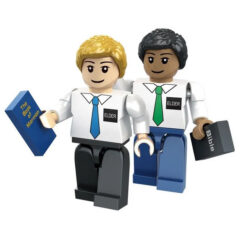
In 2014, Brick’Em Young launched its company with a set based on the Salt Lake City temple, the Church of Jesus Christ of Latter-day Saints’ flagship. Today, the Utah-based company sells plastic brick versions of 14 different temples, along with Nativity scenes and legendary missionary figurines. Two other companies — Geulah Products, based in Miami, and Aleph Brick, based in Brooklyn — sell sets depicting the Second Temple in Jerusalem.
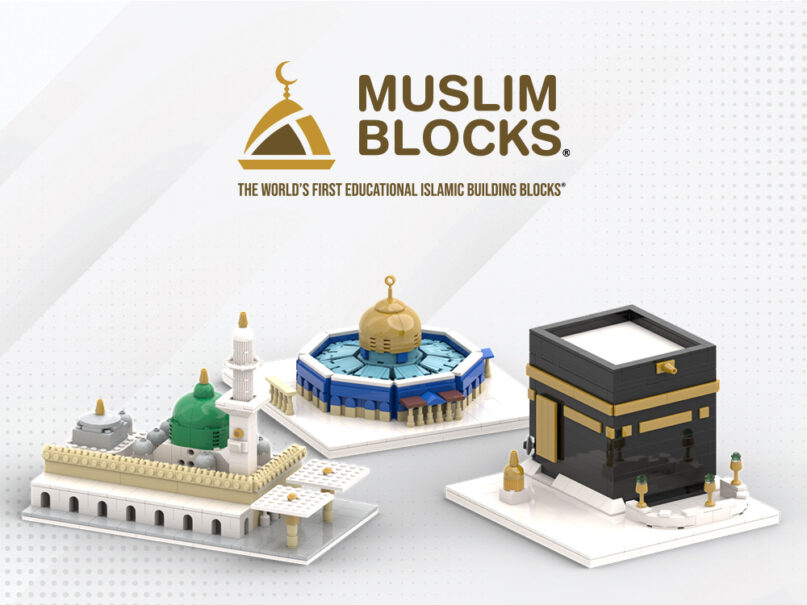
Muslim Blocks, headquartered in Saudi Arabia but shipping internationally, sells Kaaba and Istanbul’s Blue Mosque sets, among other Islamic sites.
Paul “Shlomo” Helinski, a self-described “guru” of the early internet — he founded an online gun marketplace in 1997 — started Geulah Products last year as a retirement project. The Miami resident joined the Chabad-Lubavitch movement after becoming religiously observant in his late 20s. He and his eight children enjoyed building Lego sets together, and he longed for one of the temple in Jerusalem — the holiest place for Jews before it was destroyed by the Romans in 70 C.E.
Working with a designer he found online, Helinski, 59, developed a model based primarily on a painting by Ukrainian-born Israeli artist Alex Levin. “There’s no pictures of the real beis hamikdash,” Helinski said, using the Hebrew term for the temple. “All we have are varying opinions.”
Helinski boasted about his set’s elegant details, including gray-and-white checkerboard floors and a dramatic pillar of fire and smoke in the center. Since April, he has sold around 800 units of a smaller version (742 pieces) and 500 of a larger one (3,480 pieces). The sets are available online and in some Judaica stores on the East Coast.

“The goal is to inspire (Jews) to be more religious and to be more connected, and to care about what God wants from them in their life and why they’re here,” he said.
Mendel Devlin, a fifth grader in Miami, used Hanukkah gift money he had saved over several years to buy the larger temple set. After assembling it in a few days, he proudly displays the model in his game cabinet.
“I like that it was actually proportionate,” he said, referring to its dimensions, which are recorded in Talmudic sources. “I want to design my own (set) of the third temple, which is going to be slightly bigger.” (The third temple, according to prophecy, will be built on the Temple Mount prior to the return of the messiah.)
The Bible has long inspired Lego builders and content creators. Atheist artist Elbe Spurling illustrated more than 400 Bible stories out of Legos, and Go Chatter Studios is producing stop-motion videos of Biblical scenes using just the bricks and figurines.
Lego itself did not sell any sets pertaining to religion or warfare until last year, when, to much fanfare, the Danish company released its Notre Dame Cathedral in Paris set, with a whopping 4,383 pieces and a $229.99 price tag.
A spokesperson for Lego Group suggested more sets with religious significance are being considered. “Our policy on architectural landmarks with religious connotations, culture and history is evolving, as we will begin to consider representation of such buildings in our extensive product portfolio,” the spokesperson said in a statement. “Each set will be carefully selected in tribute to its significant cultural and historical relevance.”
Helinski and Sutton both attest that running a religious toy company is not all fun and games, especially in this economy and political climate. Helinski had to pay 25% import tariffs on his sets during the Trump administration’s trade war with China earlier this year. U.S. customs also seized his shipping container for chemical testing, almost causing him to miss the Passover gift-giving season. Some customers reported sets arriving minus a few pieces. (He mails replacement pieces to customers himself and said future sets will come with spare parts.)
“It’s been a huge learning experience,” Helinski said. “I probably have broken even now, but I haven’t made a big profit yet.”
Sutton faced a production delay related to a single custom-designed piece: a headpiece for the priest figurine with Hebrew letters embossed on it. He also found himself in hot water after releasing an animated promotional video featuring the priest speaking in a stereotypically New York Jewish accent, which Sutton said offended some Jewish viewers.
Sutton, who said he was going for something light-hearted, didn’t mean to cause any offense.
Suzanne and Tim Calton founded Brick’Em Young while doing missionary work in China, according to an advertisement in Deseret News. The name is a play on Brigham Young, the second president of the LDS Church.

“We have some customers who have collected all 14 temples that we have, and we’re actually planning on coming out with even more temples and more sets that correspond with the Bible and other Book of Mormon themes,” CEO Burgandy Brittain said in a television interview in September. (The company did not respond to requests for comment.)
In creating the Wilderness Tabernacle, Sutton collaborated with two young designers in Missouri, Graham and Gareth Gidman. The brothers, who run a design firm called The Brick Duo, used software called Studio and refined their design more than a dozen times. They said they tried to be as accurate as possible, referring to descriptions of the tabernacle found in the book of Exodus as well as modern artistic renderings.
“In the original design, the walls of the tabernacle were just wood (colored),” Gareth, 21, explained. “I later found in the Bible that the walls were overlaid with gold, so we switched the bricks to a shiny metallic gold color. That was one of the biggest changes that we made.”
The brothers grew up building Lego sets and have been creating custom designs since 2020. This was their first foray into religious themes, an experience they found especially rewarding as evangelical Christians.
“It’s an amazing way for kids and adults alike to interact with the stories and the truths in the Bible,” Graham, 25, said.
Danielle Swayze’s three children had an opportunity to play with a prototype of the tabernacle earlier this year. “As a home-schooling mom, I believe there’s so many distractions in this world, especially distractions that take you away from Christ and his teachings,” the Arkansas resident and friend of Sutton’s said. “I love that (the tabernacle) is based on Biblical truth.”
Sutton has already started production on two more sets, both of which derive from the New Testament and were designed by The Brick Duo.
“I want to create sets that I think are cool, and that other people think are cool as well,” Sutton said.