
Photo-Illustration: Intelligencer; Photo: AP Images
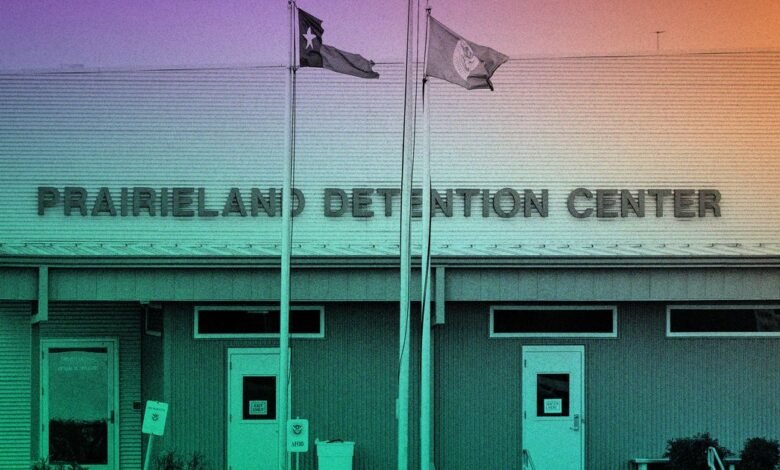
Days after the killing of Charlie Kirk in September, the Department of Justice announced a crackdown on “antifa,” or anti-fascist groups. Federal prosecutors soon brought terrorism charges against a group of activists who had been arrested during a protest outside Prairieland Detention Center in North Texas, accusing them of having ties to antifa. Attorney General Pam Bondi called antifa a “left-wing terrorist organization” the same day, and that same month, President Donald Trump tried to designate antifa a “domestic terror group,” though there is no federal legal basis for him to do so. He then issued National Security Memorandum-7, which cited the Prairieland case and Kirk’s murder as proof of “organized political violence from the left,” Texas Monthly reported. This wasn’t the first time Trump or his officials had singled out anti-fascists for legal threats, but it was the first time the federal government brought domestic-terrorism charges against alleged antifa members.
The charges stem from an incident that occurred on July 4, 2025. As The Guardian reported, protesters set off fireworks near the facility for a planned noise demonstration; a few spray-painted a guard booth and vehicles in the center’s parking lot. They damaged tires and a security camera while “two unarmed correctional officers attempted to talk” to the group, The Guardian added. From there, events are murky. At some point, former Marine reservist Benjamin Song “allegedly yelled” for his fellow protesters to “get to the rifles” and shot toward law enforcement, injuring one officer in the neck. During the trial, which began in February, the officer said he “may have pulled his gun” before Song “drew his rifle,” KERA News reported. But the judge, Trump appointee Mark Pittman, ruled it “legally invalid” for Song to claim self-defense. Prosecutors repeatedly misgendered two trans defendants during the trial and claimed the group was antifa based on reading materials they discovered in people’s homes and cars: According to The Guardian, prosecutors showed jurors a movie review of Midsommar and Hereditary titled “The Satanic Death-Cult Is Real,” anti-Trump stickers became evidence, and so did a pamphlet from the Socialist Rifle Association, which showed a person putting a swastika into a trash can.
Last Friday, a federal jury in Texas found nine activists guilty on a range of charges, including rioting, the use and carry of explosives — fireworks, as KERA News reported — and material support for terrorism. Song was convicted of attempted murder. Another protester, Maricela Rueda, was convicted of conspiring to conceal documents. Legal experts say the case has been misunderstood from the beginning and fear the convictions undermine the First Amendment. Meagan Knuth of the Dallas–Fort Worth chapter of the National Lawyers Guild spoke to me this week about the verdict and its implications for dissent in the United States.
When the federal government announced charges, it referred to the defendants as a “North Texas antifa cell.” From your legal perspective, what does the government’s language tell us about its interpretation and application of the law?
That language is clearly intentionally chosen. One of the government’s expert witnesses, Kyle Shideler of the Center for Security Policy, provided the definition of antifa used in the indictments. That intention, it seems to me, is to fit a narrative and to instill fear in folks. And to create this idea that there are domestic terrorists in the country who are working to overthrow the government, who are dangerous, who are trying to murder government officials. It’s a fearmongering tactic, something to fit an agenda and say that America is at risk of being attacked by its own citizens.
Shideler testified for the government during the trial. Could you tell me about his testimony and how it factored into the government’s case?
From my understanding, he was pretty combative to the defense attorneys. The judge, I think, had to step in at various points to remind him that he just needed to answer the question. So he clearly was there to share his own viewpoints and his own theories and agenda.
What was odd to me was he relied a lot on a book called The Anti-Fascist Handbook, which is really a nonfiction history of what anti-fascism is. [Ed. note: The author, historian Mark Bray of Rutgers University, temporarily left the United States last year after receiving death threats in the wake of Kirk’s killing.] But to laypeople and people who aren’t familiar with the book, it sounds like instructions or a manual for anti-fascists. That’s not what it is at all.
But Shideler relied heavily on that book to defend his idea that there are a group of anti-fascists in North America who are working to overthrow the government and that they have a game plan and a formula. If I recall correctly, that book wasn’t even found in the evidence. It wasn’t in any of the defendants’ living spaces. It wasn’t in anybody’s car or anything like that. He just brought it in because he thought it would help his explanation.
But the book doesn’t call for violence at any point?
No. When we think of a handbook, we think of instructions, but that’s not what it is. It’s a historical narrative of the roots of anti-fascism, so it’s not telling anybody to do anything. It’s just an account of what anti-fascism is, how it started. It has roots in Europe, and it’s an ideology. You could probably find this book at Barnes & Noble, honestly. It’s not some kind of radical zine or anything like that. It’s just a historical nonfiction text.
I think he had to use that because, when you look at the evidence, there was no evidence. These folks largely did not call themselves anti-fascists. They did not say, “Hey, we’re going to an anti-fascist gathering.” They were largely members of two different organizations, the Socialist Rifle Association and the Emma Goldman Book Club. So I think to even get the word anti-fascist in there is kind of why he had to pull this book into it.
Right, and there are socialist gun clubs across the country. We’re also talking about Texas, where a lot of people have a legal right to own and carry guns. Correct me if I’m wrong, but these activists owned weapons legally, yes?
Oh yes. They were all carrying the weapons legally. And I believe only one of them actually had a gun on them on July Fourth. To my understanding, the majority of the weapons that were found were found in people’s vehicles, secured away.
I believe one was found with a knife on their person. But again, to my understanding, all these big rifles they’re pulling out were found in the vehicles. With Meagan Morris, all of her weapons were in her car, and she was in her car as well. In fact she never exited her car.
It was interesting because during the cross-examination of the state witnesses, the defense attorneys kept clarifying, “None of this is illegal, correct? Owning these weapons isn’t illegal. You’re not saying that having these guns is illegal.” And the witness would ultimately have to admit, “No, this behavior is not illegal.”
As I understand it, the government claimed in part that these activists were trying to orchestrate an ambush of police. But it’s difficult to understand how that claim holds up if most activists were not carrying weapons at the time.
From what I saw of the case and from other attorneys I’ve spoken to, we believe the government had an almost laughable case. It was very weak. We do not believe it met the burden of proof. I truly believe it failed to prove that there was any kind of ambush or planned attack. Their Signal messages, and the recorded jail call that Maricela Rueda made to her loved ones after they were arrested, indicate that there was no ambush planned. These folks were not anticipating any shooting. They were prepared for a noise demonstration. They were prepared for a protest. There was no planned attack as the government keeps insisting.
You mentioned Signal. A lot of people use Signal; I use Signal as a journalist. Yet it seems to have been an issue, or at least the government wanted it to be an issue, in this case. Why is that, and what did prosecutors claim?
Unfortunately, the way the verdict came out, it does have wide-ranging implications for users of Signal. The government’s allegation is that this “ambush” was planned in a Signal chat. Now, this Signal chat had 200 members. My understanding is that there was a smaller thread, where the government says the disruption was planned. But again, the actual messages shown during the trial do not point to anything other than a protest and a noise demonstration. Some of the folks who are currently in jail, who are facing federal and state charges, were not even there on July Fourth. All they did was delete some Signal messages and allegedly remove people from chats. They were fulfilling their admin duties: “Okay, this person isn’t really saying things in line with our chat. I’m going to kick them out.” And they’re facing federal crimes.
Can you get into the specific charges and how the government’s case played out over the course of the trial?
The broad charge most of the defendants share is material support of terrorism. Several were also charged with attempted murder based on the idea that there was a conspiracy. So if one person maybe had that idea, you might also be found guilty simply by association. There were some rioting charges as well.
The terrorism charge in particular seems a little vague.
Because what kind of behavior constitutes terrorism? Certainly shooting off fireworks, you don’t think of that as a terroristic activity. But when the government frames the fireworks as explosives, trying to blow things up, then you can see how it can be twisted into these allegations of aiding domestic terrorism.
During the trial, prosecutors brought up zines and reading lists that allegedly had incendiary titles. They cited stickers, including one that said “Make America Not Exist Again.” Does that argument run afoul of the First Amendment in your view?
It’s a shocking verdict because a lot of this is covered by the First Amendment. We have the freedom to express ourselves even if we’re criticizing our government, even if we’re saying some things that people don’t find pleasant. The fact that the federal government tried to use stickers — some of them were anti-Nazi — is troubling. And again, when the government’s experts were pressed by defense attorneys, they had to admit, “Well, no, it’s not illegal, it’s not harmful. It doesn’t actually indicate that these folks are part of any kind of clandestine organization.” But at the end of the day, the jury decided the verdict, and they did find those folks guilty.
There is political context obviously for this case. I’m thinking of the killings of Renee Good and Alex Pretti, whom Trump officials tried to smear as domestic terrorists. Can we draw any broader implications from this context and this specific legal case about the government’s stance toward the First Amendment?
Oh, absolutely. This verdict has a chilling effect on any type of political dissent. I believe the federal government is literally trying to criminalize, and, in this case, has succeeded at criminalizing, people who are voicing and expressing disagreement and criticism of the government’s actions. And you see these patterns emerging. When the July Fourth event first happened, it was framed as an attempted murder, an ambush attack, a coordinated attack. And then you see that same language being used against Renee Good. They called her and her spouse domestic terrorists. And Alex Pretti had a gun, so it was a coordinated attack and he was planning to hurt somebody — when we know, especially in Texas, that we have a right to bear arms. He wasn’t doing anything illegal.
Even with the Cities Church protest in St. Paul, Minnesota, when journalist Don Lemon was arrested alongside activists, we see the same language. The government is calling them all domestic terrorists. They’re saying it was a violent protest. But it was a peaceful protest in a church. So the words the government uses, the terms it’s adopting, do not fit the actual individual and do not fit the circumstances.
As we’re talking, I’m reminded of the Cop City case in Georgia. And I understand that was a RICO prosecution, which, as I understand it, is not what was going on here. But are there any parallels or similarities between those cases?
Simply in the idea of the government trying to make an example of folks and scare folks who are exercising their First Amendment rights. I think there’s definitely a direct parallel that we’re seeing from Atlanta to this current situation.
In light of this verdict, do you have any broad recommendations for people who want to go out and peacefully protest ICE in their neighborhood?
I would say not to let it scare them. Be smart. Don’t come off as a threat. Even if you don’t intend to be threatening, sometimes people err on the side of overprotection and they want to wear gas masks and armor when really that can come off as threatening to laypeople. So be mindful of the appearance you’re giving off and how people might perceive that. But again, don’t let it scare you because when people react with fear it essentially tightens the noose. We give up more and more of our freedoms, we give up more and more of our rights, and it’s easier for more oppression to occur.
This interview has been edited for length and clarity.
Source link