(RNS) — The decision by the Israeli authorities to close the third-holiest mosque in Islam came as fasting worshippers were in the middle of Ramadan, the holiest month in the Islamic calendar.
Muslims fear that Israel, which said the Al-Aqsa Mosque/Al Haram al-Sharif closure was over security amid the war in Iran, will misuse the situation to normalize and further tighten the Israeli police grip on the mosque and its management. They are also concerned that the closure will be abused to dig inside and below the mosque, as Israel did when it placed electronic gates at the mosque’s entrance in 2017, and during the COVID-19 pandemic.
An estimated fewer than 5% of worshippers from all over Palestine have had access to Al-Aqsa Mosque during Ramadan anyway. In addition to age restrictions for Palestinians living in Jerusalem and inside the Green Line to visit the mosque, almost 5.5 million Palestinians in the West Bank and Gaza have been denied access during the last two decades, except for a very small number allowed to enter Jerusalem from the West Bank — and only on Friday and only in the month of Ramadan.
Osama Salah, owner of the National Palace Hotel in East Jerusalem, said that his hotelier business relies heavily on Ramadan, as do the city’s merchants and shopkeepers to overcome the economic crisis the city is facing. “We depend on Muslim tourists, especially during the last 20 days of Ramadan, when hotel occupancy rates exceed 100%. The hotel is usually packed with foreign Muslims and those from within Israel,” he told me. “However, today, due to the war with Iran, the airport closures and the closure of Al-Aqsa Mosque, occupancy rates have plummeted to a mere 2%.”
He said since the Iran conflict began, five hotels in Jerusalem have closed temporarily. “Now we are suffering terrible losses, and we had hoped that Ramadan would help us overcome this financial hardship for the next few months. But we are in a state of complete devastation,” he said. “Even during the past war, the war on Gaza, bookings exceeded 80% because the international borders and airports were not closed and Al-Aqsa Mosque was not shut down.”
Salah, who like many others who perform their prayers in Al-Aqsa, said he also feels deep spiritual sadness due to its closure.
“I don’t feel at peace, not even the spirituality of Ramadan, except when I am in Al-Aqsa,” he said.
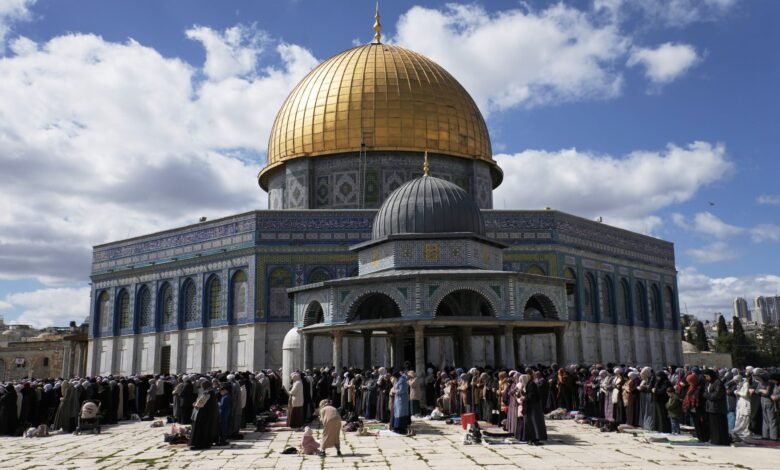
Al-Aqsa/Al Harm Al Sharif is considered the third-holiest mosque in Islam after Mecca and Madina. The mosque area compromises a major part of the old city of Jerusalem, spanning 144,000 square meters or 36 acres, and includes the silver-domed Qibla Mosque, the Dome of the Rock, the Islamic Museum and numerous other structures.
It was built by the Umayyad Caliphs in 715, and for the past 13 centuries it has been a continuous place of worship for Muslims. The only extended closure period (88 years) was when it became under the rule of the European crusaders from 1099 until 1187. During this period, the mosque ceased to function as a place of Islamic worship, serving instead as a royal palace and the headquarters for the Knights Templar. It was restored as a mosque after Saladin, the Muslim sultan of Egypt, Syria, Yemen and Palestine, liberated the city in 1187. Today, the main business street in Jerusalem, Salah al-Din, is named after him.
Except for the crusade period, the mosque was closed for a few days after the 1967 Israeli occupation and during the coronavirus pandemic. Muslims refused to enter the mosque area for 14 days in 2017, after Israel’s decision to place metal detectors at the entrances. Thousands of Muslim worshippers refused to enter the Al-Aqsa Mosque compound in Jerusalem and instead prayed in the streets to protest the security measures, and returned to worship once the metal detectors were removed by the Israelis.
Al-Aqsa Mosque has been managed by Muslims for 12 centuries. After the collapse of the Ottoman Empire, the mosque’s management was shifted to the Hashemites, the Jordanian royal family who since 1924, have been its official custodians. That year, the Supreme Muslim Council in Jerusalem accepted the guardianship of Sharif Hussein bin Ali, the sharif of Mecca and leader of the Arab Revolt.
The Jordanian Waqf ministry is responsible for day-to-day management, including paying the salaries of the nearly 1,000 guards and employees of the Islamic sites in Jerusalem. Jordan’s successive kings have also donated to the reconstruction and rehabilitation of the mosque, especially after the 1969 attempt by a radical Australian Christian Zionist to burn it down.
Some U.S. Christian Zionists, including Defense Secretary Pete Hegseth, who are supporting the U.S.-Israeli war on Iran, have sought the destruction of the mosque. Video of Hegseth from before he became defense secretary shows him calling for the rebuilding of the Jewish temple at the site, which would mean destroying the Islamic shrine.
While the Israeli police’s decision to close the mosque could be justified for security reasons, it was not done in coordination with the Waqf authorities but by armed Israeli security forces who, along with the unarmed Jordanian Waqf guards, man all entrances to Al-Aqsa.
Other holy sites were also closed due to the war, like the Church of the Holy Sepulcher and the Jewish Western Wall, but in coordination with the relevant religious authorities. Palestinian and Jordanians do not understand the justification for security measures forced on the Old City holy sites, which are stronger than measures impacting other neighborhoods in East Jerusalem.
Decisions about holy worship places should not be part of the political struggle that has emerged during Israel’s far-right-wing, racist police minister’s tenure. And while Israel has allowed gatherings of up to 50 people during the wartime emergency measures, it has refused such permission to Muslim worshipers who are certain that Islam’s third holiest mosque will not be a target of the Iranian Islamic Republic.
“I hope this nightmare for Al-Aqsa ends and that worshippers return as before,” said Sheikh Azzam al-Khatib, chair of the Jerusalem Islamic Waqf Council.
Despite the closure, extremely limited Friday prayers were held in Al-Aqsa on the third Friday of Ramadan, without worshippers. Only the imam, the preacher and a number of Waqf guards attended. As the services went on, Jerusalem residents gathered at Israeli police checkpoints to the Old City and held Friday prayers, connecting to the mosque the closest way they could.
(Daoud Kuttab is the publisher of Milhilard.org, a news site focused on Christians in Palestine, Israel and Jordan. The views expressed in this commentary do not necessarily reflect those of Religion News Service.)
Source link