
It is very difficult to write about anything in American life at this particular moment without writing about Donald Trump. The president has become so ubiquitous in American life at this point — interjecting himself into the Olympics, the Grammys and whatever else might be scrolling down his feed — that to find a place where he is absent becomes instantly noteworthy. It’s like finding that one subway car in the summer where the air conditioning still works.
After becoming the first sitting President to attend a Super Bowl last year in New Orleans, Trump stayed away from this year’s edition in Santa Clara, ostensibly because “it’s too far away.” I can report that one felt his physical absence in the stadium. I’ve been to multiple sporting events Trump has attended over the last decade, from the College Football National Championship Game in Atlanta in January 2018 (in which some fans didn’t even get into the stadium until the second quarter because of the security checks) to the 2020 CFP title game rust before Covid (in which he and Melania took a good 10 minutes to walk onto the field) to a Braves-Astros World Series game where he did the Tomahawk Chop and cheered a guy wearing a “Let’s Go Brandon!” shirt. There is a certain toxic electricity when he’s in the building, like a horror movie villain who could pop up on the Jumbotron at any time. (One who’s going to make traffic a nightmare on the way home, too.) You feel it every play.
Had the game not been held in California, it would have been tailor-made for Trump. It was the 60th Super Bowl, a big round number, featuring the New England Patriots and their longtime Trump loyalist owner Robert Kraft, who just sat with the President at the premiere of Melania last week. It was also the unofficial start of the semiquincentennial, with banners featuring two America 250 logos nearly as large as the flag itself during the National Anthem. And the Super Bowl is, after all, the most American of sporting events, a bacchanal of commercialism, patriotism, jingoism, violence and vice, all brought to you by FanDuel and your AI agent. It’s Trump’s sort of jam.
But it would have been awkward had he been here, like an ex-husband showing up at an event where he wasn’t invited. It seemed like the whole building, even surely some people in attendance who support him, felt a little relieved to have some time away from the man, like they could breathe a little easier. And maybe, for a few hours, the country — at its most universally viewed event — could act a little more like itself.
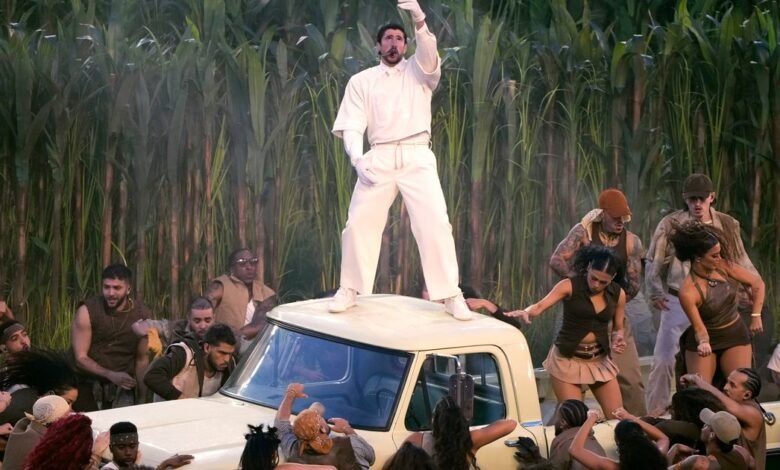
This dynamic was most obvious in Bad Bunny’s halftime show. The number one-streamed musician in the world — who Trump and his acolytes spent months fruitlessly trying to convince us is both not American and not popular — put together a vibrant, jaw-dropping Rube Goldberg machine of a performance that was as moving and unifying as it was seemingly logistically impossible. (The entirety of Levi’s Stadium gasped as one when Benito fell through the ceiling onto that table.) The joyousness of the routine—there was a wedding in the middle of it! They kept dancing outside the stadium! — felt like a direct rebuke, but also a celebration of the simple fact of being alive: Of dancing rather than scowling.
But it wasn’t just the halftime show. The whole production — pregame, game and postgame — felt packed with stuff that Trump would hate, from Green Day singing “American Idiot” (as the camera cut to Tom Brady waving blankly to the camera) to an extremely lovely, almost ethereal “America the Beautiful” from Brandi Carlisle to the simple roar of the crowd as the game got underway with the new kickoff rule that Trump dislikes so much. (He actually called it “sissy” and made sure to include it in his mid-game Truth Social post blasting Bad Bunny.) The crowd even universally booed Trump pal Logan Paul when he was shown on the big screen, which didn’t have anything to do with Trump but felt like a stand for normal human decency anyway.
None of this was an obvious frontal assault on Trump; it’s not like his name was uttered even once. But it didn’t have to be. Having this all juxtaposed directly next to the traditional Super Bowl pomp — the roaring national anthem, the fighter jets flying overhead, the cutaway to American troops overseas, Joe Montana doing the coin toss, the lousy football game, even the shirtless fan who ran on the field during a commercial break in the fourth quarter (he nearly got from one end zone to the other, the longest I’ve ever seen one of those guys make it) — all actually served as a sign of normalcy, a brief reminder that, amid all the madness of 2026, there was still a sane world left, the one you remember, displayed out there on the biggest stage our country’s popular culture has to offer.
The game itself…well, it was dull heading into the halftime show and somehow got duller afterwards. It was the second Super Bowl ever to not feature a single touchdown until the fourth quarter, and it didn’t so much end as limply run out of air and die. But the game itself has often been peripheral to the event. Each Super Bowl gets one thing — at most — that it’s remembered for. Sometimes this thing is about the football; sometimes it’s about the music; sometimes it’s about the outside world poking its head inside the stadium. Super Bowl XLII had the helmet catch; Super Bowl XL had Prince; Super Bowl LV had the stands at one-third capacity because of COVID; Super Bowl LI had the Falcons choking; Super Bowl XXVII had Justin Timberlake and Janet Jackson; Super Bowl XLVII had the lights going out in New Orleans; Super Bowl LIX had Kendrick; Super Bowl LII had the Eagles finally winning and their fans eating horse manure in celebration; Super Bowl XLIX had Left Shark. Sometimes it’s nothing at all: I know I was at Super Bowl LIII in Atlanta, and I talked to a bunch of people, I even stayed for the whole game and everything, even though it was only seven years ago, I can’t for the life of me remember a single thing that happened.
This Super Bowl will obviously not be remembered for the game. It will be remembered, in a headlining sense, for Bad Bunny. But I wonder if its ultimate value will be as a respite, however brief, from the feeling that all of America in 2026 forever had Trump lurking over its collective shoulder. At the biggest of all American spectacles, at the beginning of the celebration of the country’s 250th birthday, it wasn’t about him. It was just a big-ass American thing in which he had no role. It was nice. It was a relief. Once, it was always like this. It was a reminder that it could be like this again.