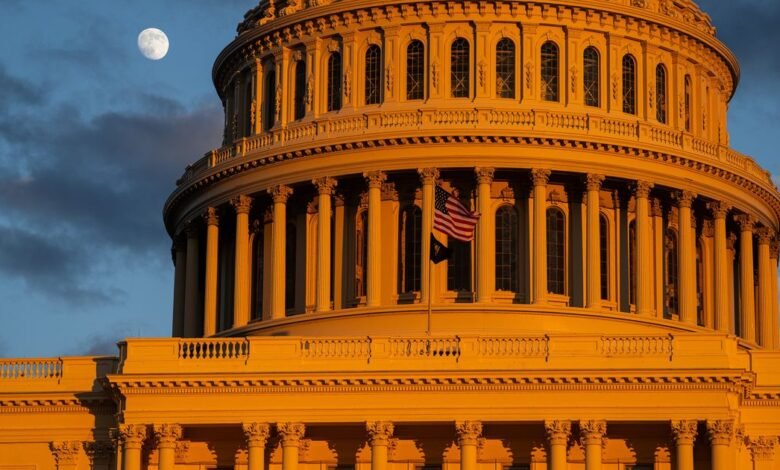

The U.S. Capitol.
Photo: Graeme Sloan/Bloomberg via Getty Images
For a while there, you could hear serious talk about Donald Trump’s brazen midterm-rigging national gerrymandering initiative backfiring. He’s faced Republican resistance in Indiana, Kansas and Ohio and suffered an unexpected judicial defeat in Utah. We could see voters overturn the extinction of a Democratic district in Missouri. Florida presents a legal and political obstacle course for GOP gerrymanderers. And of course California voters approved a pro-Democratic gerrymander on November 4.
But the biggest blow to Trump came from a federal district court panel in Texas that on November 19 struck down that state’s new pro-GOP map — the first in the whole series — as an impermissible race-based gerrymander. Five new Republican House seats hung in the balance, but relief for Trump came from a familiar source: the U.S. Supreme Court. In an unsigned “shadow docket” order (with three Court conservatives explicitly backing the decision while three liberals dissented) the Court pushed aside the lower-court ruling–in theory temporarily, but with 2026 candidate filing beginning in four days, it’s now certain Texas will use exactly the map Trump pushed on the state.
In concurring remarks, Justice Samuel Alito (joined by Justices Clarence Thomas and Neil Gorsuch) made a point of comparing what Texas Republicans did to what California Democrats did in their Prop 50. In dissent, Justice Elena Kagan (joined by Justices Sonia Sotomayor and Ketanji Brown Jackson) complained that the conservatives disregarded the lower-court finding that Trump’s own Justice Department practically drew the Texas map along race-conscious lines, and issued a “legal ultimatum” to Texas without which the gerrymander would have never taken place. But the minority’s the minority, and so the Texas power grab will proceed. If nothing else, it cancels out California’s Prop 50.
The order tersely explains that the lower-court judges acted too late in the electoral season to instruct the state to change its map and attributed racial motivations to Texas legislators when permissible partisan intent wasn’t disproved.
In terms of legal precedents, the order basically just reinforces earlier decisions by the Roberts Court keeping judges from interfering with partisan gerrymanders, even if they carry the aroma of racism. But there’s a bit of a silver lining for those who fear a really enormous midterm power grab by Trump and his allies: the order does suggest that it’s far too late in the midterm election cycle for judges to be mucking around with maps. So even if in a separate case (Louisiana v. Callais) SCOTUS chooses to gut Voting Rights Act protections of minority voting interests, it probably can’t be used to massively re-gerrymander southern districts to get rid of Black and Latino members of Congress until after the midterms at the earliest.
With Trump’s power grab back on, it remains to be seen if Republicans can flip enough House districts to defy the odds and hang onto their House majority in 2026. It’s entirely possible (given 2025 election trends) there will be enough of a Democratic wave to keep some of the targeted districts in Texas and other red states in the blue column, while marginal Republican districts fall into their laps. But Trump and his justices have done all they can to insulate the GOP from the judgement of voters.
Source link